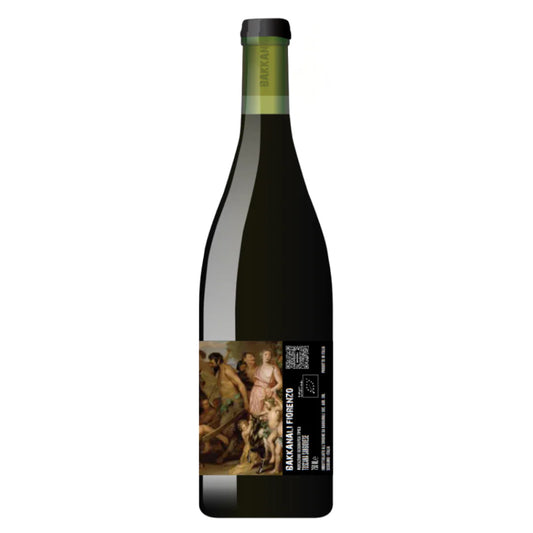

Welcome to the sixth stop on our journey through wine's great regions. After Piemonte's Nebbiolo in the north, we head down into central Italy, to the gentle hills between Firenze and Siena. Here one grape reigns above all others: Sangiovese.
For many, Toscana is the very embodiment of Italian red wine. It is the home of Chianti, Brunello and the so-called Super Tuscans, and it is a region where tradition and renewal have lived side by side for decades. In this part we look at the grapes, the areas and the classic wines, and at what actually makes a Tuscan red recognisable in the glass.
Hvad du lærer
- Which grapes shape Toscana, with Sangiovese at the centre
- What sets Chianti, Brunello and Super Tuscans apart
- The most important areas in the region
- What the Tuscan wines are typically characterised by
Toscana in brief
Toscana lies in central Italy, in the hill country between Firenze and Siena. To the west the region stretches out towards the coast in an area called Maremma, which runs down towards Grosseto and south of Livorno. That gives a region with great range, from cooler high-lying inland hills to warmer, maritime coastal zones marked by Mediterranean vegetation such as holm oak, cork oak, juniper and wild herbs.
The region holds a large number of DOCG and DOC zones as well as many IGT classifications. It may sound confusing, but the logic is the same as in the rest of Italy: a classification system introduced in 1963 and since reformed, which divides the wines according to origin and rules. The IGT category (Indicazione Geografica Tipica) was created precisely as an intermediate tier, and as we shall see later it came to have great importance for Toscana.
The two most planted grapes in the region are Sangiovese and Trebbiano. Both are thought to descend from wild vines that the Etruscans cultivated thousands of years ago. Trebbiano is a white grape that is very productive and resistant to disease, with naturally high acidity. It is mostly used as a blending grape and rarely contributes much aroma or fruit on its own. On the coast the white Vermentino is on the rise. It has a long history in Toscana, ripens late and thrives in the maritime climate.
Sangiovese and the classic wines
Sangiovese is the red grape around which everything in Toscana revolves. It is considered Italy's most widespread and most studied native red grape. DNA research has shown that it descends from the Tuscan grapes Ciliegiolo and Calabrese Montenuovo, so its roots are firmly planted in Italian soil.
One of the things that makes Sangiovese fascinating is that it appears under many names depending on where in the region it is grown. In Montalcino it is called Brunello, in Montepulciano Prugnolo Gentile and near Grosseto Morellino. It is the same grape, but locally named, and that says a lot about how closely tied Sangiovese is to the individual areas.
The grape comes in several sub-types, broadly divided into two: Sangiovese Grosso with larger berries, and Sangioveto with smaller berries, traditionally used in Chianti. Sangiovese is a vigorous grape that is very sensitive to its environment and notoriously difficult to ripen fully. It is also naturally low in colouring compounds (anthocyanins), and that is an important key to understanding the region. Historically Sangiovese has been blended with local grapes such as Canaiolo and Colorino to give the wine more colour and body. In more recent times international grapes such as Cabernet Sauvignon and Merlot have arrived, and that leads us straight on to the great wine types.
Chianti, Brunello and Super Tuscans
These three names belong to the first things you should know about Toscana.
Chianti
Chianti is the region's best-known wine type and is built first and foremost on Sangiovese, often in the company of local grapes. It is a wine that ranges widely in style, from fresh and easy-drinking versions to more serious and ageworthy wines from the better sub-areas. Common to them is the Tuscan core: fresh acidity, firm tannin and a fruit that leans towards cherry and red fruit.
Brunello
In Montalcino, south of Siena, they make Brunello, which is based exclusively on the local clone of Sangiovese. It is a more concentrated and ageworthy style that typically spends some years in barrel before it is bottled. Brunello is among the region's most esteemed wines and shows how much depth and structure Sangiovese can reach when conditions are right.
Super Tuscans
Super Tuscans arose when producers began blending Sangiovese with international grapes such as Cabernet Sauvignon and Merlot, or making wines entirely outside the traditional rules. Because the wines did not fit the rules of the time, some of the region's most sought-after wines were for a period sold as simple table wine. That was one of the reasons the IGT category was created, and today these wines have gained their own recognised place. Many of them have their roots in the coastal area around Bolgheri in Maremma, where modern investment has grown markedly. The area was in fact malaria-stricken marshland until drainage projects in the 1930s opened it up for agriculture.
It is worth remembering that Toscana is often compared to Bordeaux, both for its commercial impact and its market-oriented approach. That duality of deep tradition and business sense is part of the region's character.
How the wines taste
So what can you expect in the glass? The Tuscan reds made from Sangiovese have some recurring traits that are worth knowing.
- Acidity: Sangiovese gives wines with fresh, lively acidity. That is a big part of why they suit food so well, especially the Tuscan kitchen with tomato, olive oil and herbs.
- Tannin: The tannins (the astringent compounds from skins and seeds that give the dry sensation in the mouth) are typically firm and noticeable. They give the wines structure and the ability to age.
- Fruit: Expect notes of red fruits and cherry, often with a touch of herbs, spice and an earthy, almost dusty tone.
- Colour and body: Because Sangiovese is low in colouring compounds, the wines are rarely dark and impenetrable. When a wine is blended with Cabernet or Merlot, it often gains both colour and rounder fruit.
Where a wine has spent time in oak barrels, you may meet notes of spice, vanilla or smoke that settle over the fruit. In general, though, it is the acidity and the firm tannin that define the classic Tuscan experience.
Kort fortalt
- Toscana lies in central Italy and stretches from the hills between Firenze and Siena to the coast in Maremma.
- Sangiovese is the dominant red grape and appears under names such as Brunello and Prugnolo Gentile depending on the area.
- Chianti, Brunello and Super Tuscans are the region's three most important wine types to know.
- Sangiovese is naturally low in colour, which has historically led to blends with local and later international grapes.
- The classic wines are characterised by fresh acidity, firm tannin and notes of red fruits and cherry.
Ofte stillede spørgsmål
Are Brunello and Chianti made from the same grape?
Yes, both are built on Sangiovese. In Montalcino the grape is simply called Brunello, and the wines from here are typically more concentrated and ageworthy, while Chianti covers a broader range of styles.
What is a Super Tuscan, really?
It is a term for Tuscan wines that break with the traditional rules, often by blending Sangiovese with Cabernet Sauvignon or Merlot. They originally fell outside the system, but today have their own recognised place.
Klar til næste skridt?
Now you have got hold of Sangiovese and the Tuscan classics, from the fresh Chianti to the deep Brunello. In the next part we travel on towards north-eastern Italy and explore Veneto: From Prosecco to Amarone, where everything from lively mousserende vin to powerful Amarone belongs.
If you fancy tasting your way into Toscana, do drop by our selection and find a bottle that tempts you. And remember that the best combination is always the wine you like with the food you feel like having. Enjoy the exploration.