
-
Markus Molitor Zeltinger Sonnenuhr Riesling Auslese 2015 1.5L
Regular price €163,95 EURRegular priceUnit price per€217,95 EURSale price €163,95 EURSale -
SALE - SAVE 21%
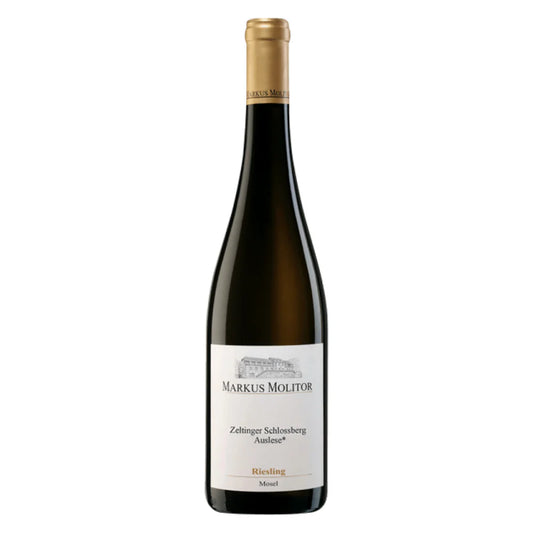
Markus Molitor Zeltinger Schlossberg Riesling Auslese 2015
Regular price €81,95 EURRegular priceUnit price per€103,95 EURSale price €81,95 EURSale -
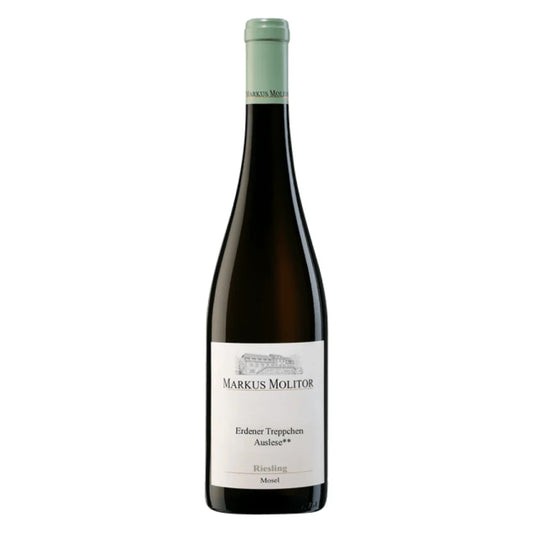
Markus Molitor Erdener Treppchen Riesling Auslese 2015
Regular price €81,95 EURRegular priceUnit price per€112,95 EURSale price €81,95 EURSale -
 SALE - SAVE 21%
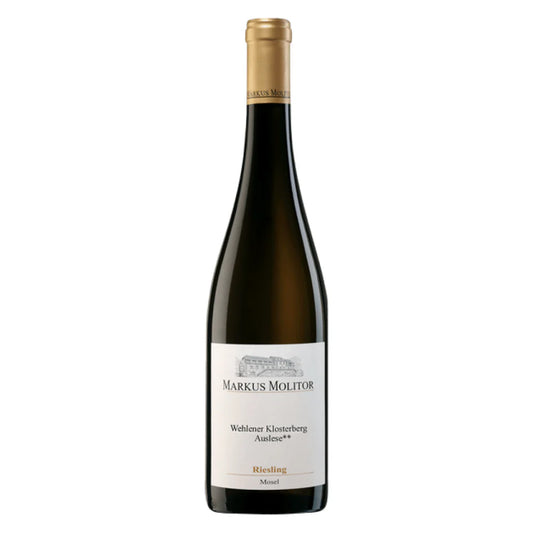
Markus Molitor Wehlener Klosterberg Riesling Auslese 2015
Regular price €40,95 EURRegular priceUnit price per€51,95 EURSale price €40,95 EURSale -
 SALE - SAVE 28%
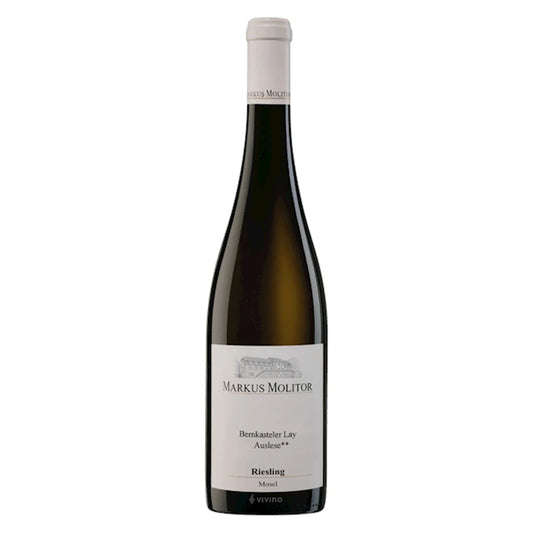
Markus Molitor Bernkasteler Lay Riesling Auslese 2015
Regular price €81,95 EURRegular priceUnit price per€113,95 EURSale price €81,95 EURSale
Mosel is Germany's oldest wine region, where the Romans first seriously introduced viticulture along the Mosel, Saar and Ruwer rivers. Today the region covers more than 8,000 hectares spread across around 125 wine villages, and it accounts for the highest proportion of white grapes in all of Germany. That is precisely why this is where you find some of the country's most characterful white wines.
About half of the vineyards lie on steep, terraced slopes, several of them with a gradient of over 30 degrees and a few reaching all the way up to 70. This makes machine harvesting impossible, so the majority of the grapes are picked by hand. The subsoil shifts from Devonian slate on the steep slopes at Saar, Ruwer and Mittelmosel to clayey slate and greywacke in the lower part and shell limestone up towards Luxembourg. This variation leaves clear imprints in the glass.
Riesling is the region's undisputed main grape and is grown on by far the largest part of the area. It defines the style, from crisply dry wines to off-dry and the noble-sweet versions that Mosel is world famous for and which fetch record prices at auction. Alongside Riesling, Müller-Thurgau plays a role, just as the historic Elbling is still grown in the upper part of the valley near Luxembourg. Since 2023, Spätburgunder (Pinot Noir) has overtaken Elbling as the region's third most important grape, a hint that Mosel also holds more than white wine.
At Copenhagen Wine we carry wines from Mosel with a focus on this very provenance. The selection leans on the region's strengths, where Riesling naturally takes centre stage. If you are looking for a wine with fine acidity, stony minerality and a cool, northern expression, Mosel is an obvious place to begin. There is something here both for the person who loves the bone-dry and the one who appreciates a discreet sweetness balanced by fresh fruit.